
Hong Kong is a popular choice for foreign entrepreneurs, investors, and expats due to its territorial tax system, competitive tax rates, and business-friendly environment. Under the Hong Kong tax system, businesses and individuals are generally taxed only on income and profits sourced in Hong Kong. Whether you are setting up a company, expanding into Asia, or relocating to Hong Kong, understanding the local tax rules is essential for effective business and tax planning.
In this guide, you’ll learn:
- Understanding the Hong Kong tax system: How territorial taxation works and what it means for foreign-owned businesses.
- What taxes you will pay in Hong Kong: An overview of profits tax, salaries tax, and property tax.
- Tax compliance after incorporating a Hong Kong company: Key filing requirements and annual obligations.
- Frequently asked questions about Hong Kong taxes: Quick answers to common tax questions from foreign business owners and expats.
This guide provides a practical overview of the Hong Kong tax system and the key considerations for operating a business in Hong Kong.
Understanding Hong Kong’s tax system
Hong Kong’s tax system is known for its simplicity, competitive tax rates, and territorial basis of taxation. Unlike many jurisdictions that tax worldwide income, Hong Kong generally taxes only income and profits sourced in Hong Kong. Combined with the absence of VAT, GST, capital gains tax, and dividend withholding tax, this approach has helped establish Hong Kong as a leading international business and financial hub.
The tax system is administered by the Inland Revenue Department (IRD) and is built around three direct taxes:
- Profits tax
- Salaries tax
- Property tax
Businesses and individuals also benefit from a relatively straightforward tax framework and Hong Kong’s extensive network of Double Taxation Agreements (DTAs), which help reduce the risk of double taxation on cross-border activities.
What taxes will your company pay in Hong Kong
Hong Kong primarily taxes business profits, employment income, and rental income through three main taxes: Profits Tax, Salaries Tax, and Property Tax. The tax you pay will depend on your business activities, employment status, and whether you earn income from property in Hong Kong.
| Tax type | Applies to | Tax rate |
| Profits Tax | Business profits sourced in Hong Kong | 8.25% or 16.5% |
| Salaries Tax | Employment income | 2% to 17% |
| Property Tax | Rental income from Hong Kong properties | 15% |
Profits Tax
Who needs to pay profits tax in Hong Kong?
Profits Tax applies to individuals, companies, partnerships, and other entities carrying on a trade, profession, or business in Hong Kong. In general, Hong Kong taxes profits that arise in or are derived from Hong Kong under its territorial taxation principle.
The following types of entities may be subject to Profits Tax:
- Local corporations: Companies incorporated in Hong Kong on their taxable local profits.
- Overseas companies: Foreign corporations that have a branch, office, or permanent establishment conducting business operations in Hong Kong.
- Sole proprietorships and partnerships: Individuals and business partnerships carrying on a trade, profession, or business in Hong Kong.
- Clubs and associations: Organizations and associations that derive taxable profits from activities conducted in Hong Kong.
If you are planning to establish a business in Hong Kong, you may also find our guide on Hong Kong company incorporation helpful.
How does Hong Kong determine whether profits are taxable?
For businesses with cross-border operations, the key question is not where the company is incorporated, but where the profits are generated. When determining the source of profits, the Inland Revenue Department (IRD) examines the activities that directly produce the profits and where those activities take place.
Depending on the nature of the business, the IRD may consider factors such as:
- Where are services performed? For consulting, marketing, design, or IT businesses, the source of profits is often linked to where the services are actually delivered.
- Where are contracts negotiated and concluded? For trading businesses, the place where purchase and sales contracts are negotiated, concluded, and executed can be an important factor.
- Where do the key profit-generating activities take place? The IRD looks at the operations that create the profits and where those activities are carried out. For example, maintaining an office and employees in Hong Kong may indicate that income-generating activities are conducted in Hong Kong and that the profits are Hong Kong-sourced.
- Where are decisions implemented rather than simply made? The location of directors or board meetings is only one factor and does not, by itself, determine the source of profits.
What are the profits tax rates in Hong Kong?
Hong Kong applies a two-tiered Profits tax regime that offers a reduced tax rate on the first portion of assessable profits. The applicable tax rates depend on whether the business is incorporated or unincorporated.
For corporations:
| Assessable profits | Tax rate |
| First HKD 2 million | 8.25% |
| Above HKD 2 million | 16.5% |
For unincorporated businesses (sole proprietorships and partnerships):
| Assessable profits | Tax rate |
| First HKD 2 million | 7.5% |
| Above HKD 2 million | 15% |
Example: If a Hong Kong limited company earns HKD 3 million in assessable profits, the first HKD 2 million is taxed at 8.25%, while the remaining HKD 1 million is taxed at 16.5%.
Important: Under Hong Kong’s two-tiered Profits Tax regime, only one entity in a group of connected entities can benefit from the reduced tax rates. If two or more entities are connected under the Inland Revenue Ordinance (IRO), the remaining entities will be taxed at the standard Profits Tax rate. Businesses with group structures should review the connected entity rules to confirm their eligibility before claiming the two-tiered regime.
When is profit tax assessed in Hong Kong?
Hong Kong’s tax year, known as the Year of Assessment (YA), runs from 1 April to 31 March of the following year.
A company’s Profits Tax is generally assessed based on the profits reported in its financial year ending within the relevant Year of Assessment. For example, if your company’s financial year ends on 31 December 2025, the profits for that financial year are generally assessed in the 2025/26 Year of Assessment.
After the financial year ends, the company prepares its financial statements, calculates its assessable profits, and files a Profits Tax Return with the Inland Revenue Department (IRD). Filing deadlines depend on the company’s financial year-end.
Salaries Tax
Who needs to pay salaries tax in Hong Kong?
Salaries Tax is imposed on income derived from employment, offices, and pensions in Hong Kong. For business owners, Salaries Tax commonly becomes relevant when a company hires employees in Hong Kong or when a director or shareholder receives remuneration from the company. In other words, Salaries Tax may apply to individuals receiving employment income connected to Hong Kong, including:
- Employees of Hong Kong companies: Individuals receiving salaries, wages, bonuses, commissions, or allowances from a Hong Kong employer.
- Company directors: Directors receiving directors’ fees from a Hong Kong company.
- Foreign entrepreneurs and business owners: Founders who pay themselves a salary through their Hong Kong company should consider whether Salaries Tax applies. Employment income such as salaries, bonuses, allowances, and directors’ fees may be taxable when paid for services performed for the business in Hong Kong. However, dividends paid to shareholders are generally not subject to Salaries Tax.
- Expats working in Hong Kong: Foreign nationals performing employment duties in Hong Kong.
What are the salaries tax rates in Hong Kong?
Hong Kong applies a progressive tax system, with rates ranging from 2% to 17% on net chargeable income.
| Net chargeable income (HKD) | Tax rate |
| First 50,000 | 2% |
| Next 50,000 | 6% |
| Next 50,000 | 10% |
| Next 50,000 | 14% |
| Remaining income | 17% |
In addition, a standard tax rate may apply in certain situations. The final Salaries Tax liability is generally calculated using the available methods, with the lower amount payable.
What are the deductions for salaries tax?
Individuals may be eligible for deductions and personal allowances that reduce their taxable income. Common examples include:
- Mandatory retirement scheme contributions
- Approved charitable donations
- Self-education expenses
- Personal, spouse, and dependent allowances
The availability of deductions and allowances means the effective tax burden is often lower than the highest marginal tax rate.
Property Tax
Who needs to pay property tax in Hong Kong?
Property Tax applies to income derived from land and buildings situated in Hong Kong. It is generally charged on rental income received by property owners and is separate from Profits Tax and Salaries Tax.
For foreign investors who own residential, commercial, or industrial properties in Hong Kong, Property Tax may apply if the property generates rental income.
For example:
- Individual property owners: Individuals who rent out residential, commercial, or industrial properties in Hong Kong.
- Joint property owners: Co-owners receiving rental income from jointly owned properties.
- Overseas property owners: Foreign individuals or entities earning rental income from Hong Kong properties.
- Corporations holding investment properties: Companies owning Hong Kong properties for rental purposes, although exemptions may apply in certain circumstances.
What are the property tax rates in Hong Kong?
In Hong Kong, property tax is charged at a flat rate of 15% on the net assessable value of the property.
The tax is charged on the net assessable value of the property, which is generally based on the rental income received after deducting a statutory allowance for repairs and maintenance.
What are the exemptions for property tax?
In certain cases, companies that are already subject to Profits Tax on rental income may be exempt from Property Tax. This helps prevent the same rental income from being taxed twice under different tax categories.
Property owners should assess their circumstances carefully to determine whether Property Tax, Profits Tax, or an exemption may apply.
Need help with Hong Kong taxes?
Annual tax and compliance requirements for Hong Kong companies
After incorporation, Hong Kong companies are subject to ongoing accounting, tax, and statutory compliance obligations. Many foreign founders assume tax obligations only arise when a company starts generating revenue. In reality, Hong Kong companies are subject to ongoing compliance requirements even if the company has not generated revenue, incurred losses, or claims offshore profits. Failure to comply may result in penalties, estimated tax assessments, additional filing fees, or regulatory action.
Most companies should monitor four key obligations each year:
- Maintain proper accounting records
- Prepare audited financial statements
- File tax returns with the Inland Revenue Department (IRD)
- Complete annual corporate filings with the Companies Registry
Prepare accounting records and financial statements
What is it?
Accounting records and financial statements form the foundation of a Hong Kong company’s annual tax and compliance obligations. The financial statements provide a summary of the company’s financial performance and position during the financial year, while the underlying accounting records support the figures reported in those statements.
In most cases, Hong Kong companies are required to prepare annual financial statements and have them audited by a Hong Kong Certified Public Accountant (CPA) before filing their Profits Tax Return with the Inland Revenue Department (IRD). It applies to companies which:
- Generated revenue during the year
- Made a profit or incurred a loss
- Conducted business primarily outside Hong Kong
- Intend to claim offshore profits
For companies involved in cross-border transactions, accurate accounting records are particularly important because they may be used to support the source of profits and the tax treatment adopted in the Profits Tax Return.
What documents are required?
A company should maintain sufficient records to explain its business activities, income, expenses, assets, and liabilities throughout the financial year.
For companies claiming offshore profits, additional supporting documents may be required to demonstrate where the key profit-generating activities took place. These may include contracts, emails, shipping documents, travel records, meeting records, and evidence showing where services were performed or transactions were negotiated.
A practical way to think about documentation is that every significant revenue or expense item reported in the financial statements should be supported by evidence that can be reviewed during the audit process or requested by the IRD if necessary.
Annual audit
What is it?
An annual audit is a statutory requirement for most Hong Kong companies. The purpose of the audit is to allow an independent Hong Kong Certified Public Accountant (CPA) to review the company’s financial records and express an opinion on whether the financial statements fairly reflect the company’s financial position and performance.
For many companies, the audit is more than a compliance exercise. The audited financial statements are typically required for:
- Filing the Profits Tax Return with the Inland Revenue Department (IRD)
- Supporting offshore profit claims and tax positions
- Opening and maintaining corporate banking relationships
- Investor due diligence and fundraising
- Group reporting and corporate governance purposes
Foreign business owners are often surprised to learn that an audit may still be required even if the company:
- Has no revenue;
- Has incurred losses;
- Has only a small number of transactions;
- Conducts business primarily outside Hong Kong.
This is because the audit focuses on verifying the company’s financial activities and statutory reporting obligations, not simply whether the company has generated taxable profits.
What documents are required?
The auditor will typically request documents that support the company’s financial statements and significant transactions during the financial year.
Common audit documents include:
- Bank statements and bank confirmations
- Sales invoices and customer contracts
- Purchase invoices and supplier agreements
- Payroll records and employment contracts
- Loan agreements and financing documents
- Fixed asset schedules and supporting invoices
- Shareholder resolutions and corporate records
- General ledger, trial balance, and financial statements
Depending on the nature of the business, auditors may also request additional evidence to verify revenue recognition, expenses, related-party transactions, or cross-border activities.
For companies claiming offshore profits, supporting evidence becomes particularly important. Auditors may review documents such as evidence of where negotiations and business activities took place, trading contracts, email correspondence, etc. In practice, the audit process is usually smoother when accounting records are maintained throughout the year rather than assembled shortly before the filing deadline. Well-organised documentation can help reduce audit queries, shorten the audit timeline, and support the positions ultimately reported in the company’s Profits Tax Return.
File the profits tax return (PTR)
What is it?
The Profits Tax Return (PTR) is the annual tax filing submitted to the Inland Revenue Department (IRD) to report a company’s taxable position for a Year of Assessment. It is the key document used by the IRD to determine whether a company has Profits Tax liabilities and how much tax is payable.
For newly incorporated companies, the first Profits Tax Return is typically issued around 18 months after incorporation or commencement of business. After that, companies generally enter the IRD’s annual filing cycle and are required to submit a Profits Tax Return each year.
An important point for foreign founders is that filing obligations generally exist even if the company:
- Has not started generating revenue
- Is loss-making
- Has minimal business activity
- Believes its profits are offshore
- Has no tax payable for the year
Many entrepreneurs mistakenly assume that an offshore claim eliminates the need to file a tax return. In reality, the company is generally still required to report its position and provide supporting information where necessary. Because the Profits Tax Return is supported by the audited financial statements and tax computation, it is typically the final stage of the annual accounting, audit, and tax compliance cycle.
What documents are required?
A typical Profits Tax Return filing may include:
- Completed Profits Tax Return form issued by the IRD
- Audited financial statements
- Profits tax computation
- Tax schedules and supplementary forms (where applicable)
- Supporting documents requested by the IRD
Depending on the company’s activities, additional documentation may also be required. For example, companies claiming offshore profits may need to provide evidence supporting the source of profits. It might include service agreements, customer and supplier contracts, etc.
Companies with related-party transactions, overseas operations, or cross-border income streams may also be required to provide additional disclosures and supporting documentation to substantiate their tax treatment. In addition, businesses that maintain organized accounting records throughout the year are generally better positioned to complete their Profits Tax Return efficiently and respond to any queries raised by the IRD during the review process.
Complete annual corporate filings
What is it?
Hong Kong company must comply with annual corporate filing requirements administered by the Companies Registry. These obligations are separate from tax filings with the Inland Revenue Department (IRD) and focus on keeping the company’s statutory information accurate and up to date.
The most important annual filing is the Annual Return (Form NAR1). The purpose of this filing is to confirm key company details, including its registered office, directors, company secretary, shareholders, and share capital structure.
It is important not to confuse the Annual Return with the Profits Tax Return (PTR):
- The Profits Tax Return reports the company’s tax position to the Inland Revenue Department (IRD).
- The Annual Return (NAR1) updates the company’s corporate information with the Companies Registry.
For a local private company, the Annual Return must generally be filed within 42 days of the company’s incorporation anniversary each year. Missing this deadline can result in substantially higher filing fees and other compliance consequences.
What documents are required?
The Annual Return is primarily based on the company’s statutory records and corporate information.
Companies should ensure the following information is accurate and up to date:
- Registered office address
- Directors’ particulars
- Company secretary details
- Shareholders and shareholdings
- Share capital information
- Significant corporate changes made during the year
In some cases, many compliance issues arise not because companies fail to operate properly, but because changes to directors, shareholders, or company details are not updated in a timely manner. Maintaining accurate statutory records throughout the year helps ensure that annual filings can be completed efficiently and reduces the risk of penalties or administrative complications.
For overseas-owned companies, keeping corporate records current is particularly important when opening bank accounts, conducting due diligence, applying for financing, onboarding investors, or supporting cross-border business activities. Accurate corporate records often become one of the first items reviewed by banks, regulators, and professional advisers.
Hong Kong compliance deadline
Hong Kong companies can choose their own financial year-end (FYE), with 31 December and 31 March being the most common options. The selected year-end affects when financial statements are prepared, audits are conducted, and tax returns are filed.
A newly incorporated company does not usually receive its first Profits Tax Return immediately. In most cases, the Inland Revenue Department (IRD) issues the first tax return approximately 18 months after incorporation, regardless of whether the company has commenced business operations. This initial period allows the company to establish accounting records and prepare its first audited financial statements.
Once the company becomes operational, compliance generally follows the same annual cycle:
Bookkeeping → Financial Statements → Audit → Tax Return Filing → Tax Assessment → Tax Payment
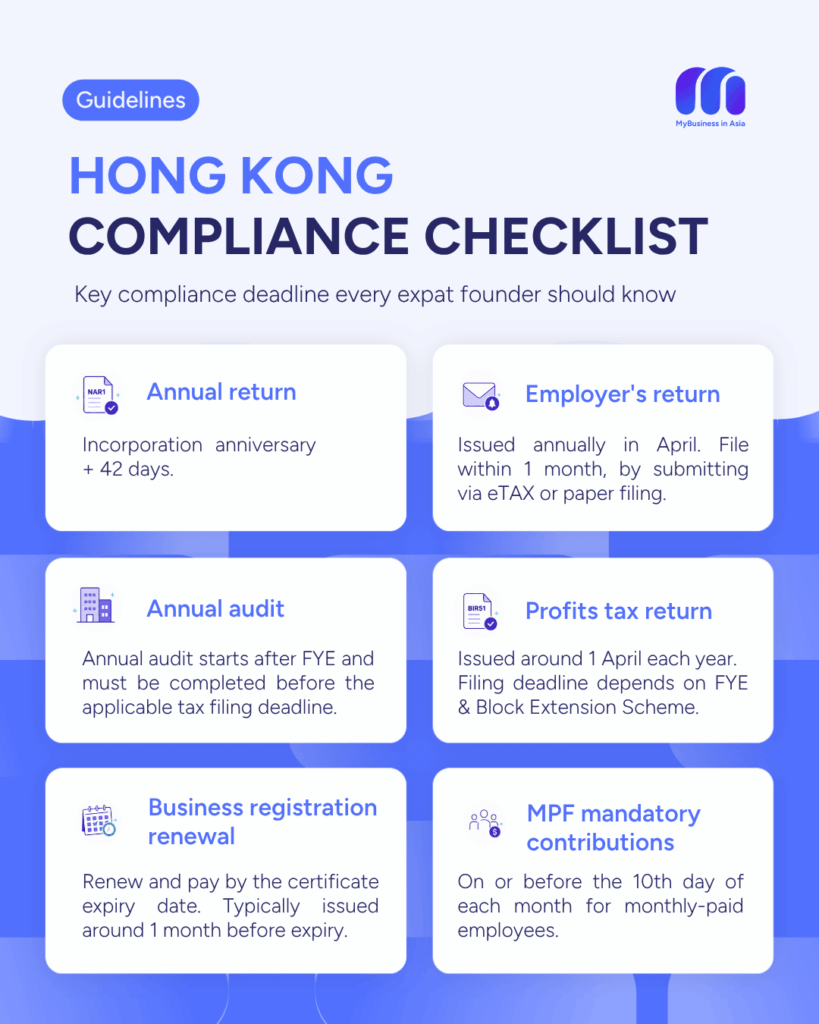
To help you visualize the annual compliance cycle, the infographic below outlines the key deadlines for tax filing and corporate compliance in Hong Kong.
FAQs
Question: Does Hong Kong tax foreign-sourced income?
Hong Kong generally follows a territorial tax system, meaning only income and profits arising in or derived from Hong Kong are subject to tax. For businesses with international operations, the source of income is an important factor in determining tax liability.
Question: Does Hong Kong have tax treaties with other countries?
Yes. Hong Kong has entered into a network of Comprehensive Double Taxation Agreements (CDTAs) with many jurisdictions to help reduce the risk of double taxation and facilitate cross-border business activities.
Question: Are dividends taxable in Hong Kong?
Dividends distributed by Hong Kong companies are generally not subject to withholding tax or Salaries Tax, making Hong Kong an attractive location for business owners and investors.